Buy anything from 5,000+ international stores. One checkout price. No surprise fees. Join 2M+ shoppers on Desertcart.
Desertcart purchases this item on your behalf and handles shipping, customs, and support to Thailand.
⚡ Illuminate like a pro, command your scene with every shot!
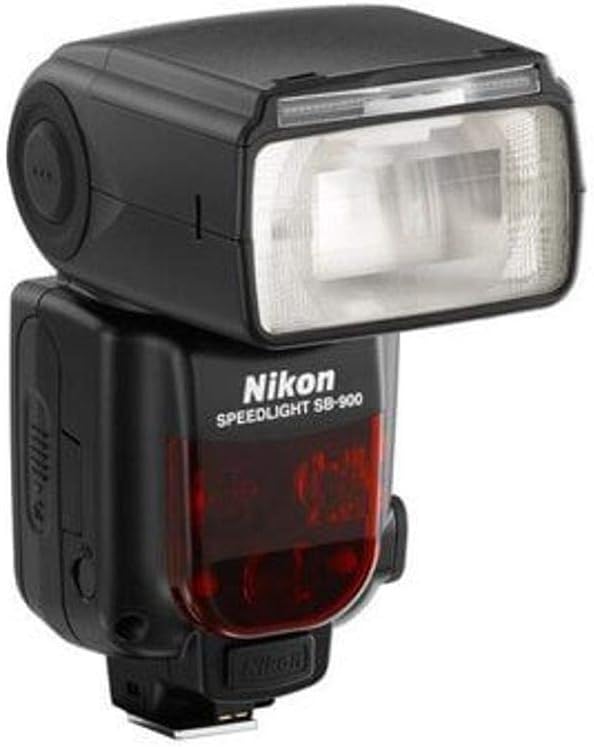
The Nikon SB-900 AF Speedlight is a flagship external flash designed for Nikon DSLR users seeking professional-grade lighting control. It features a powerful guide number of 48 (ISO 200), wireless commander mode managing up to 3 groups plus unlimited remotes, and an ultra-fast auto zoom head covering 17-200mm lenses. With three selectable light distribution patterns and advanced i-TTL balanced fill-flash, it delivers versatile, precise illumination. Its compact design includes thermal cut-off protection for durability and supports firmware updates, making it a reliable, creative lighting tool for demanding photographers.
| ASIN | B001BTG3OQ |
| Audio Recording | No |
| Battery Average Life | 60 minutes |
| Battery Life | 60 minutes |
| Best Sellers Rank | #226 in Shoe-Mount Flashes |
| Brand | Nikon |
| Built-In Media | Nikon SB-900 AF Speedlight i-TTL Shoe Mount Flash |
| Camera Flash | external |
| Color | daylight |
| Compatible Devices | Nikon cameras (DX or FX format) |
| Compatible Mountings | Nikon F |
| Connectivity Technology | Wireless |
| Continuous shooting speed | 5 |
| Customer Reviews | 4.5 out of 5 stars 386 Reviews |
| Exposure Control Type | Manual, Manual Flash (with Nikon Creative Lighting System digital and 35mm SLR cameras), i-TTL Balanced Fill-Flash with CLS compatible cameras |
| Flash Sync Speed | 1/5 or lower |
| Global Trade Identification Number | 00018208048076, 04960759025661 |
| Guide Number | 34 meters/111.5 feet (at ISO 100, 35mm zoom head position) |
| Hardware Interface | AV Port |
| Has Self-Timer | Yes |
| Included Components | Nikon SB-900 AF Speedlight i-TTL Shoe Mount Flash |
| Item Dimensions D x W x H | 4.7"D x 3"W x 3"H |
| Item Part Number | FSA03801 |
| Item Weight | 415 Grams |
| Manufacturer | Nikon |
| Manufacturer Part Number | 4807 |
| Maximum Shutter Speed | 1/250 seconds |
| Minimum Shutter Speed | 0.2 |
| Model Name | SB-900 |
| Model Number | 4807 |
| Mount Type | Hot Shoe Mount |
| Number of Batteries | 4 AA batteries required. |
| Self Timer Duration | 10 |
| Shooting Modes | Auto, On, Off, Rear Curtain Sync, Slow Sync, High Speed Sync |
| UPC | 182080480764 018208048076 |
| Unit Count | 1.0 Count |
| Water Resistance Level | Not Water Resistant |
| Wireless Technology | Bluetooth |
T**Y
If you want to know the truth please read
Okay, here's the (long winded) truth about the flash and it's "thermal shutdown problem". First off, let me say that I have much experience in using different camera flashes and studio strobes as well as some repairing of them. I will start of by saying that this flash is the best portable camera flash in it's class that I have EVER used. Nikon knows what they are doing. They have an extremely high standard of quality and reliability. When they see a quality improvement / guarantee need, they will apply it. In the case of the SB-800 to the SB-900 one of the biggest and least appreciated quality assurance guarantees is the thermal cut off feature. Which, by the way, can be turned off or on. So all of those who are b****ing about it, just read your manual and turn it off! Okay, time for a cheesy quote: "With great power comes great responsibility". Nikon knew this. (speculation) They also knew the general public would not really understand the limitations of the flash in hand. So they incorporated a safety mechanism: "Thermal cut off", to prevent overheating due to extended maximum flash output. This sort of "circuit breaker" is also found in some pro studio strobes. Studio strobes usually use AC power and provide a much greater power output and are more likely to overheat and sometimes "blow out", so it is common to see some kind of safety mech built in to them. Portable camera flashes run off batteries and do not produce any where near the kind of power output than said strobes; so there is usually no critical need for such a safety. With the SB-900 however (and SB-800), Nikon has managed to build a very compact flash (yes, I mean compact if you consider it's power capability) that recharges very quickly and sustains a consistent powerful output. To do this, it requires a huge demand on the IGBT (like a capacitor) and sustained overheating would result in failure and eventually even damage to the flash. Of course they could have "pushed it" and programmed it to trigger at a much higher temp threshold or even eliminated the option all together. But it is good to have that feature. It's not that the flash overheats "easily", it's that the flash is offering more than maybe it should. With that much more power, comes that much more heat. (Especially from a compact unit without any cooling fans) Now for my silly analogy: "It's like the difference between driving a car that only goes 65mph (other flashes) and driving car that goes 100mph (SB-900 / 800). With the 65mph car, you can't get a speeding ticket (overheat / failure) on the freeway with the speed limit of 65mph. With the 100mph car you won't get a ticket either, until you start driving 100mph for an extended period of time on the same freeway. Then you will likely be stopped for speeding. Then, having a radar detector (thermal cut off feature) will warn you when a cop is around the corner and that you should slow down from 100mph to 65mph. You may ask yourself: why that speed limit? Of course, safety: limitations of the car and driver. Then you may ask: why make a car that goes 100mph if it is not safe to go that fast? (here is where my analogy doesn't follow exactly, but you get my point) You may have a need to go 100mph and it is good to have the ability. Often it may be fine to do so. Just know you are running the risks." If you really need to turn off the thermal feature and shoot at max output consistently, chances are it will function just fine. Yes, it will get hot, yes your batteries will drain faster, and yes you will wait longer for each subsequent recharge but nothing major will happen: because it's designed to do that and it's a Nikon made in Japan. Just know this: Nikon or not, all electronics still have to follow the basic laws of physics. It's not ultimately good for the IGBT and circuitry to sustain such powerful flash firing as some do. You run the risk of degradation and failure. I've seen it happen, albeit rare. Basically, you should feel confident about the performance and reliability of this flash. It doesn't get any better...yet.
B**B
SB-900
I have several SB-800s and SB-600 so my primary basis for comparison is against those. Basically this strobe is excellent but some of the whistles and bells are of questionable utility. The things I really like about the strobe are pretty much the things that make the SB-800 great. - Remote capability via CLS system - Su-4 slave mode - External high voltage battery pack compatibility (plug on front) - Nice guide numbers for a battery unit. - Zoom that can be controlled manually or by the camera. - Selectable beep for when unit has recycled. - Can be used as a three channel master for Nikon's CLS system The things this unit does that are improvements compared to the SB600 and SB800 that I like and what motivated me to purchase it are: - Zoom to 200mm and not just 85 mm (600) or 105 mm (sb800). - Different beam patterns - Head rotates a full 180 degrees in both directions (requires a little surgery on an SB800 to fix this stupid problem on them) - Manual thumb switch for on/off and selecting remote and master modes instead of the slow menu system. These are what I wanted/liked and why I went for this strobe unit. The things I don't like or question the value of them: - I don't like the size. It is bigger than the SB800 some of which admittedly is needed for the zoom optics for the lamp itself but the lower body is bigger too. I can open SB800/600s straight out and stand them upright in a Think Tank camera pack but the 900 has to be folded 90 degrees and/or laid down and it takes up much more space. - The colored gel thing to automatically set the white balance with the camera is something I don't care for. I suppose some folks that want idiot-proof will like this but it is simply added cost with no benefit for most photographers who know enough to use gels. Much of the time we specifically don't want the camera to change white balance to tungsten if we put a CTO gel on the strobe. And the green gel to match the strobe to fluorescent lights is of little use because most fluorescent lights any more need more than just a green gel on the strobe to obtain an acceptable match. Green alone is ok for old fluorescent lights but most lights now need a green, full CTO and often a bit of yellow as well to make a decent match. So this feature adds cost but no value. - I have a real grudge against the 900 because it allowed Nikon to discontinue the 800. Bad move. I'll probably buy more 600s since you can get two of those for the price of one 900 and have more light to boot. - I have mixed reaction to the modeling light. I like that when you push the button it stays on for a couple seconds, kind of handy to let you use both hands for a brief moment to adjust things. However, with the 800 there were dedicated buttons, one to operate the modelling feature (it strobes at a fast rate and lower output so you can see how the light hits your subjects) and one to just trip the flash. The 900 has only one button and you have to select in the setup memu which function it will provide, flash or modelling light. That kinds of sucks. - The new Radio Poppers Jr Studio verson wireless triggers have a function and accessory (cube) that can provide manual control of the power for many TTL strobes. A thing called a "cube" makes the connection but electrically the 900 is different so it doesn't interface with the Radiopopper Jrs. like the 600 or 800 do. Sure the RadioPopper PX or older P1 system can provide manual control, sort of (its actually provided by the Nikon CLS), but the Jrs are less than half the price. Probably not significant for most photographers, just something a few will miss. Interestingly, the price of used SB800s are often, and most all old stock new ones are going for more than the new price for an SB900 so clearly the 900s aren't meeting some of the needs for many photographers. That is probably mostly the size thing, but many Nikon photogs have a collection of 800s and there is value in having stuff be the same, expecially with assistants helping you.
A**S
Dealing with hot flashes
Current status: Amateur (hobby) photographer Level of expertise: Intermediate Camera: Nikon D7000 Prior experience with Speedlight Flash: None - first flash I got the SB-900 to improve the quality of my portrait photography, and was not disappointed. The manual was a bit daunting, so armed with info from youtube, I bravely set off to photograph a Christmas party. I got some wonderful photos using the diffuser (which is included with the SB-900) and with the flash angled up both 45 and 90 degrees, bouncing the light off the freshly painted white ceiling. Angling it behind my head also got some fantastic results. Halfway through the proceedings, the flash started beeping, and the screen showed that it had overheated. After ruling out that my photos weren't too "steamy" to cause flash failure, I let it cool off for a bit. Using the built-in flash in the interim effectively proved that there isn't any going back there after using a Speedlight, so I was relieved when it cooled down enough to start working again. Subsequent research on youtube has shown that the major culprit may have been the type of battery I used. I was using rechargeable Eneloops to save on buying tons of batteries, but apparently, rechargeables only give 1.2V instead of the 1.5V supplied by regular batteries, causing the internal wiring to overheat with continuous flash use. However, the rechargeables allow for faster flash recovery times, so if you're not covering a big event, rechargeables will work fine for say, a portrait session. Other than that, using the TTL setting (automatic setting meaning "Through the Lens") also contributes to premature overheating, and if you switch to manual and reduce the flash power, you should not have the problem. The SB-900 comes with a carry case, a diffuser, a pack of gels with the holder, and a stand for use off-camera. It also has a small diffuser and white reflector that retract into the head of the flash. This model has lots of features that I have not yet explored, including the different auto and manual settings, the ability to work as a part of a flash system, and the zoom, which goes up to 200mm. The few weak spots are that the SB-900 is bulky, and if kept in the case, it won't fit in my regular camera bag, and the fact that it is quite pricey for an amateur who isn't recovering costs from customers. In conclusion, I would recommend this flash highly to anyone interested in improving their portrait and low light shots, or exploring the fascinating world of flash photography. Professionals already know that it's a great flash, and we amateurs will have to do a lot of homework to learn to properly use all the features. Youtube, here I come. Amanda Richards, December 28, 2011
P**O
Lots of misinformation in other reviews of this flash
I can't believe the amount of misinformation presented in customer reviews for this product. First of all, it is true -- Nikon added a thermal cut-off that allows the customer to be absolutely certain that the flash never overheats. If that sensor is turned on, the flash can't shoot fast enough or often enough for professional usage -- particularly for weddings. Try shooting the bridal party introductions at a reception, for example. Even if you limit yourself to two flash pops per couple, by the time the third couple is walking in the door, the thermal shutdown will kick in, and you'll be swearing at the thing. However, you can simply turn the sensor off. In my experience, the flash is no more delicate than previous Nikon and Canon speedlights. Every Nikon and Canon flash has a duty cycle carefully described in their manual that virtually all professionals ignore and exceed, and yet -- most of us get years of usage from the flashes with no problem. I can't tell you the number of times I've taken batteries out of my flashes that were simply too hot to hold, and the flash housing was burning hot too -- but the thing just kept on working. So I think, if you turn off the thermal cut-off, the SB-900 will behave just like earlier flashes like the SB-800, in terms of overheating. So the simple answer is. . . if you turn off the thermal sensor, the SB-900 is at least as useful as a professional tool as it's predecessors -- no more, no less susceptible to overheating. I don't know why Nikon and Canon are so conservative in the duty-cycle ratings of their flashes, but I've talked with dozens of fellow pros over the years -- we all abuse the flashes, and we rarely have issues. I'm not saying that it's not possible to abuse these speedlights to the point where they will die -- I'm just saying I have used them professionally and repeatedly put hundreds of very fast, high-power pops on them, significantly exceeding the rated duty cycle, and have yet to kill a Canon or Nikon speedlight. As far as batteries go, Nikon fully supports and recommends the use of NiMH batteries -- both normal and Eneloops. The chart in the manual shows NiMH as being the best combination for a good number of pops and the shortest recycling time. Only the expensive Lithium non-rechargeables have better battery life, but they have a recycle time almost double NiMH. Alkalines give the smallest number of pops, and have the second longest recycle time. So fear not -- the SB-900 is the nicest speedlight I've owned yet -- I have three of them, and I like it far better than it's predecessors. Turn off the thermal sensor as soon as you take the flash out of the box, load it up with Eneloop batteries, and you will experience flash nirvana. Finally, I highly recommend the SD-9 accessory battery pack. Load it up with Sanyo Eneloops, and you can easily shoot an entire wedding (actually, probably two weddings) without swapping batteries, while enjoying the fastest recycle time possible with this flash. Update after using three of the SB-900s for a full wedding season: We encountered some flakiness (random flashing of the flashtube and AF assist lights) which I THINK is related to a loose fit of the SB-900's hot shoe base in the D700 camera's hot shoe. So far, it seems like applying Deoxit contact cleaner to both the camera and flash camera contacts makes the problem go away.
J**O
Decent speedlight - wish it didn't overheat
This is a decent speedlight. But I have two issues with it. 1) The hole where you put the sync cord or the cord to the Pocket Wizard is too big and the cord falls out. The only way to fix this has been for me to keep a rubberband around the cord pushing it into the hold tightly. Even a screw-in cord hasn't been successful. The other issue is the over-heating. It doesn't happen that often but it's annoying when it does happen. At least the unit stops firing and doesn't commit suicide by overheating or that would make me REALLY angry. But overall, it gets the job done and batteries last pretty long too.
C**N
Nikon SB-900
The Nikon SB-900 is an excellent flash that is very easy to use. The menu and controls are about as straightforward and intuitive as they can be. I like the ability to switch the camera to on, remote, and master with a single switch. An advantage of this flash over the SB-600 is that it has the "old fashioned" auto capability via a sensor on the flash itself. This yields more consistent results than Balanced TTL flash for outdoor shots. Just set the flash to Auto Aperture or Auto and dial in -1.0 to -2.0 flash compensation for consistently outstanding outdoor fill flash shots. I recently used the SB-900 to shoot a fair during the day. With the flash set to Auto Aperture and flash compensation set to -1.0, every shot was well exposed. The fair organizers were blown away with the results. I used the high speed FP function with a shutter speed of 1/800 to shoot skateboarders catching some air. With this function you can use the flash all the way up to the camera's maximum shutter speed. The wireless flash function works as advertised. I have used it both indoors and outdoors in the shade using the D300's built in flash as the master (trigger). I haven't used the color compensation filters, but they will be valuable for shooting indoor events to match flash color with ambient light. Regarding the thermal cutoff feature mentioned in some reviews, I haven't used the flash to shoot multiple full-power shots in rapid succession. However, with Nikon's current pro DSLRs you can increase the ISO to 1000 or higher without degrading image quality. Higher ISOs require lower flash power. Lower flash power means less heat. Less heat means a reduced likelihood of triggering the thermal cutoff. Your flash batteries will also last longer if you increase ISO. I don't find the size or weight of the flash to be an issue. During the fair mentioned above, I carried the SB-900 attached to a Nikon D300 with a Nikkor 18-200mm lens and Op-Tech neoprene strap for over 5 hours without complaint. The only drawback to this flash is that it's a bit pricey. In my opinion, a price point under four-hundred dollars would be good.
R**H
Damaged!!!!
When I took it out of the box, I was a little disappointed because it had several scratches all over it. This item was labeled "used-very good." By Amazon's standards, this means it should be a 9 out of 10. Appearance wise, I would have given it a 7 out of 10. I decided I could overlook the scratches. The batteries were dead, so after I switched them, the flash seemed to work well. I took about 50 practice pictures of my family. However, when I tried to switch the dial from "on" to "slave," I discovered the dial was indeed broken. It would only switch between on and off, and would not go to slave or master mode. This is unacceptable for a "very-good" condition flash! I am very disappointed! When I ordered this product, the seller had a note that you could only return within 14 days. I thought that was odd, but went against my gut feeling and went ahead and ordered it. I guess they were hoping I wouldn't use the flash right away!
T**R
Great with reservations.
I hesitated to buy this flash. The SB-600 was dated and no replacement was rumored, and I really wanted to buy one flash one time and not have to think about it. I purchased it thinking I was a non-professional and I would not run into the thermal shutdown issue. I purchased ENELOOP NiMH batteries and I started shooting. I've only experienced thermal shutdown twice - and that was with bounce flash + a very dark room + iso 200 photography with a 70 or 80 photos in a row. If you set your camera to iso100 in a dark room and really push the flash, you can hit this really quickly but is that realistic? I am disappointed that there is such a cloud of controversy surrounding it. It may hurt resale. My experience was that when the temperature gauge hits it's midpoint, you will quickly get to thermal shutdown in the next couple of photos. The batteries were not even warm when taken out, nor was any part of the flash that I could touch. Once shutdown occurs, you can not turn on the flash and get into the menus to turn off the thermal protection circuit until the unit cools down. Plan accordingly. Either turn off thermal shutdown protection before and monitor the temperature frequently or plan to wait about 5 or 10 minutes for the unit to cool down. If you are a pro, you probably have more than one flash anyway and can swap them though this is inconvenient. All in all, it is a powerful excellent flash. It helps me make fantastic memorable photos. If you can't afford a $2000+ full frame camera to shoot low light and high ISO, then having the best flash is the next best alternative. Plus as you grow your photography skills and upgrade equipment, this flash will continue to serve you well. The flash has the nikon CLS (creative lighting system) so you can put the flash off-camera and shoot from different angles, or use an umbrella to get nice diffuse light. It also comes with a ton of extras -- nice storage case, some gels for coloring the light coming out of the flash, a diffusion dome, a white bounce card. I definitely recommend this flash though I hope some day soon, Nikon issues a firmware fix or services these very expensive flashes and rids us of the temperature issues.
T**L
Great Flash, But No Manual In The Box
This flash is wonderful; especially for shooting portraits indoors using it off camera (remote) and bouncing light off ceilings and walls. I recently bought my second SB 900 (yes, it is *that good*) from Bargains 2000 via Amazon so as to have more complex, and easily portable, lighting set-ups. (Read posts by others here for detail about the flash itself.) In an effort to shave a few ££s off the price I clicked on the 'xxx New' link under the main Amazon price. There was one on offer - from Bargains 2000 - at a slightly lower price so I bought it. Delivery was speedy, two days. The flash appears to have come via Amazon France. The box was the standard Nikon box, BUT DIDN'T CONTAIN THE OFFICIAL MANUAL or the neat little colour booklet on lighting set-ups for different situations that was in the box when I bought my first SB900 from a shop. All other components were present. Luckily I already had these booklets - and already used a SB900 before; but if you were new to this flash (or Nikon flashes generally) the lack of a manual could cause serious problems. No one else that has posted here seems to have complained about this, so it could be one of the ways a few ££s was shaved off the official price. Something to bear in mind if thinking of going for one of the cheaper options available via Amazon. I'd also suggest those new to SB flashes to get hold of a book on Nikon's Creative Lighting System. I got 'Nikon's Creative Lighting System Digital Field Guide' by J. Dennis. Useful also for lots of other advice including basic model poses for portraits. The manual goes through the settings; but doesn't really explain how to get the best from them. I also found some videos on You-tube that explained how to set up a commander/slave system on a D90 that I found useful when I first started using a SB900. It is quite simple, once you know how to do it.
K**A
gut
ich nutze ihn gern, die Bilder werden gut.
(**ス
問題なく使用出来ました。
当方の所有しているニコンの一眼レフに装着して試してみました。 全く問題なく使用できました。 中古でもこんなに安く値付けがされているものはなかなかありません。 箱や説明書はありませんが大変満足しています。
K**S
Très bon produit
Le mien a lâché du coup j ai repris le même et le vendeur au top et rapide
A**5
Arrivato nei tempi promessi.
Arrivato nei tempi promessi. Il flash e ottimo ma ho un problema con le pile e penso debba andare in assistenza
Trustpilot
2 weeks ago
1 week ago