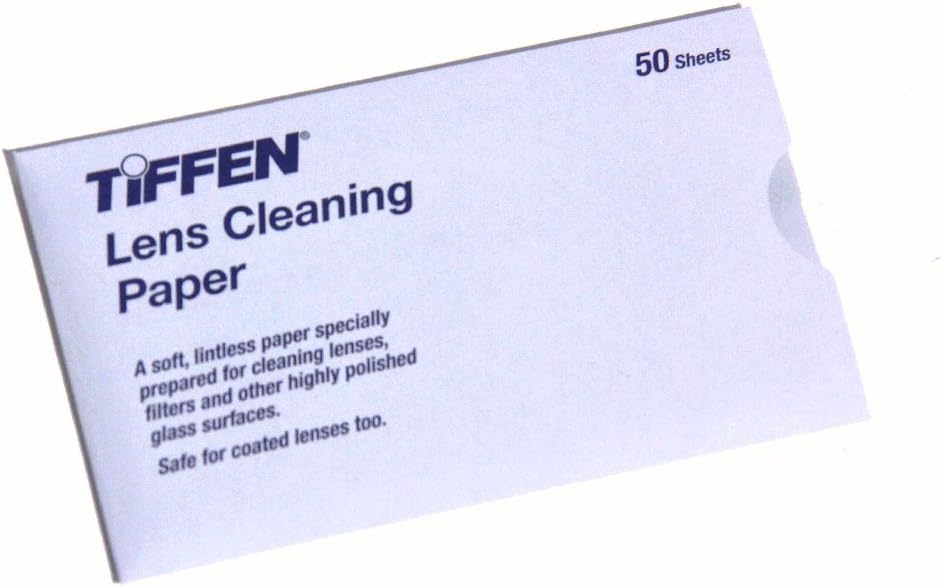




Tiffen Lens Cleaning Tissue Paper (Pack of 50)
Product ID: 1193531
Details
- BrandTiffen
- Colorwhite
- MaterialPaper
- UPC610563295722
📏50 ultra-soft sheets
🛡️Non-scratching, lint-free
🇺🇸Proudly American made
Buy anything from 5,000+ international stores. One checkout price. No surprise fees. Join 2M+ shoppers on Desertcart.
Desertcart purchases this item on your behalf and handles shipping, customs, and support to Thailand.
🔍 Keep your vision sharp, your style sharper!
Tiffen Lens Cleaning Tissue Paper offers 50 high-quality, non-scratching sheets made in the USA, trusted by professionals for maintaining pristine optical clarity on cameras, binoculars, eyeglasses, and other delicate lenses. Combining legacy craftsmanship with modern value, these tissues deliver lint-free, safe cleaning for all your precision optics.
| ASIN | B004ZZOMZ0 |
| Audio Recording | No |
| Best Sellers Rank | #104,567 in Health & Household ( See Top 100 in Health & Household ) #151 in Eyeglass Cleaning Tissues & Cloths |
| Brand | Tiffen |
| Color | white |
| Customer Reviews | 4.5 out of 5 stars 370 Reviews |
| Enclosure Material | Paper |
| Item Weight | 0.02 Pounds |
| Manufacturer | Tiffen |
| Manufacturer Part Number | EK1546027SINGLE |
| Material | Paper |
| Model Number | EK1546027T-1 |
| Number of Items | 1 |
| UPC | 610563295722 |
| Unit Count | 50.0 Count |
A**R
All American Made-Quality-Value-Non-Scratching Material-Just Like Eastman Kodak Used To Make.
This is top quality Lens Tissue- and useful for All Optical Instruments at Value Priced Levels, it is used for my Heavily Used Marine Binoculars on exclusive basis- after Eastman Kodak ceased lens tissue production. Having been in the Photographic Retail Business for a number of years and now in the Cruise Maritime/Container Ship Merchant Marine Business having clean and clear Binocular Optical Glass is a absolute must for Navigation, Safety at Sea, and especially Ship's Bridge Watch, plus Lookouts, and these Lens Tissues are part of good scheduled maintenance, along with good Optical Cleaning Fluid. Buy it and you will appreciate American Quality Superb Lens Tissue!
R**N
Great
Works great for my microscope lens
D**H
Great value and actual lens-cleaning tissues, not wet wipes
These will actually work on camera lenses and won't leave a residue. And they're not extortionately-priced. That's two wins!
T**E
The best lens tissue
The best lens tissue since the old Kodak brand.
N**D
Kodak tissue is no more. So, these are the best now.
Well, Kodak no longer makes these tissues. Most small photo shops, where you would pick one up for fifty cents or a dollar, are gone. Apparently Tiffen took over (or always made?) the Kodak tissue making factory. So, these are the same or close enough and are basically, the only game in town. Zeiss makes a “Wet One/KFC” style lens cleaning thing. It’s pretty good too. Walmart sells em cheap either in electronics or the camping and hunting area. These are only for lenses! You’ll have to clean up your greasy fingers with a real hand wipe. It is important to also buy a good air blower (do not user canned air) to blow out the glass before using these cleaners. I have tried many blowers and the Giotto Rocket is the best hands down. Get the big one. Get one for use at home and one for your bag (if you are a pro). After you give the lens a good blowing off, use a bit of this tissue to dust off any particles that blowing would not remove. Then carefully take a tissue, put a few drops of lens cleaning liquid (for camera lenses) on it and very, very gently wipe the leans clean from the center to outside. Be VERY gentle! Heres the part they do not tell you. Get an old 100% cotton T shirt - FOL cotton undershirts are good. It MUST be 100% cotton and clean. Cut some handkerchief size square pieces. Discard the arm pits, neck seam, and bottom seam. And any other stitched parts. Jut the cloth is all you will use. After the cleaner has evaporated off, you may see some discoloration of it left on the lens. With your mouth, breath some vapor onto the lens so it fogs up and wipe it with the cotton cloth. It should now look perfect. Some old timers skip the cleaner and this tissue entirely and just do the warm breath and the cotton cloth. I only use the cleaner and cloth (or the Zeiss wipes) on used lenses I buy that are dirty or at the end of a long trip with the equipment in dirty places and outdoors a lot. I found that the newer lenses do not seem to leave as much residue however, it also seems to depend on the type of lens, macro vs. tele vs. prime and brand too. Cheaper seems to leave behind more residue than more costly.
E**C
They work!
I love these little things. When I first got them I was a little skeptical because they seemed a little rough. But after using them, all my worries disappeared. I use them at work for cleaning glass and plastic filters on medical equipment. Using them dry will work somewhat but it may not remove everything. When I use them with lens cleaner solution, they work wonderfully. Always spotless. I have never ever had them scratch but you should always be careful of how hard you press. I trust them enough to clean very expensive equipment. And they never leave any fibers behind. They are a little on the small side as you can see from the photos. If you are cleaning something a little larger, you will have to use multiple sheets. One problem I do have is with how they are packaged. They are all stacked inside a little fold of paper. Whenever I open the paper to take one out, the top few sheets get carried up with it and fly out. If you upset the delicate balance in which they are stacked, you will have a difficult time putting them back together neatly. It's not hard, just time consuming. They do come in an envelope which is extremely useful. They would fly everywhere if not for that envelope. I wish they were attached together and you could just rip off what you need. But this is getting very nitpicky. As long as they clean well (which they do) I will keep buying them.
J**L
Good for camera lenses, not so much for eyeglasses
Some have touted these lens cleaning tissues as doing a good job cleaning eyeglasses. However, these tissues are nearly useless for cleaning eyeglasses. Human faces produce oil. Oil gets on glasses. These tissues simply cannot deal with facial oil on eyeglasses. I have put them in my camera bag, as they work great for their intended purpose of cleaning the surface of camera lenses.
E**E
the light passing through the scratch is affected like a prism would bend it
This paper is identical to the old Kodak lens tissue, the Gold Standard. As an old assistant cameraman from NYC, learned a whole lot of ways to clean $30,000 lenses: NEVER use anything but lens tissue, NEVER flat, NEVER first. Blow the surface off first, then carefully, circularly brush with a lipstick brush that has never been touched, or roll a piece of lens tissue from the end (like a joint, not touching the center section) and pull it apart in to two halves. The torn edge is the softest, non-scratching "brush", used wet and dry. The enemy of a lens is the scratch. Dust on a lens is of no consequence to the quality of the image until it is thickly filthy. Hopefully, it will "puff" off with a rubber blower. A scratch degrades the image: the light passing through the scratch is affected like a prism would bend it, arriving at the focal plane out of place. So, DON'T CLEAN A LENS UNLESS IT'S GOT A FINGERPRINT ON IT (corrodes the coatings as well as degrades the image) or other serious caca. NEVER 'scrub' the lens, lightly make perfectly circular swipes with a moistened (lens cleaning fluid only) - NEVER DRY and NEVER FLAT. If you happen to scratch the surface, a circular scratch is far less damaging to the image. Wad the tissue, soak it and "wash" the lens several times until the surface problem is gone. When it drys, you'll see 'stains', like an oil slick on water. Repeat to minimize these. NEVER have your finger pressing on a flat piece of tissue - wet or dry - (a sure way to make a scratch if a tiny piece of grit is present) until the very last step in cleaning. You've removed all the surface contamination, so NOW you can use two or three layers dry (slightly damp is better) and flat (wadded is safer) to lightly, circularly, remove the last of the 'stains'. So, BLOW, BRUSH, WASH, DRY. Miss any of these first three steps and you risk leaving grit on the surface - a scratch waiting for you to create it. I usually used around 10 -12 sheets of tissue for each cleaning - NEVER use the same piece of tissue twice, and if suspect you touched the surface of the tissue with anything - finger, table surface ,etc. - throw it away, it's contaminated. Note: Can't IMAGINE using even a pristine, always-kept-in-a- sealed-container microfiber cloth more that ONCE. You're just kidding yourself and micro scratching your lens...
Trustpilot
5 days ago
2 weeks ago