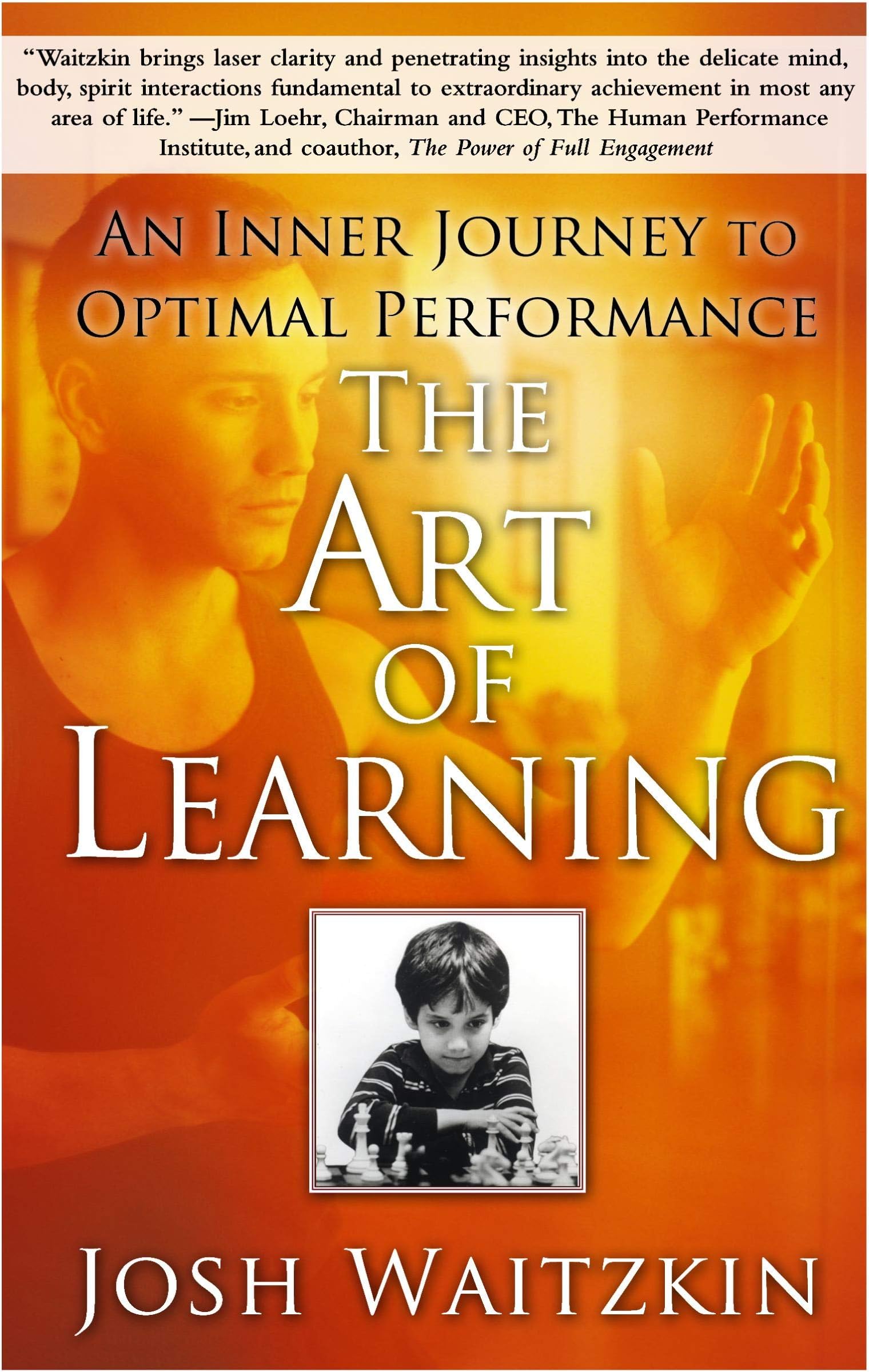
The Art of Learning: An Inner Journey to Optimal Performance
Product ID: 1641935
Buy anything from 5,000+ international stores. One checkout price. No surprise fees. Join 2M+ shoppers on Desertcart.
Desertcart purchases this item on your behalf and handles shipping, customs, and support to Thailand.
In his riveting new book, The Art of Learning , Waitzkin tells his remarkable story of personal achievement and shares the principles of learning and performance that have propelled him to the top—twice. Josh Waitzkin knows what it means to be at the top of his game. A public figure since winning his first National Chess Championship at the age of nine, Waitzkin was catapulted into a media whirlwind as a teenager when his father’s book Searching for Bobby Fischer was made into a major motion picture. After dominating the scholastic chess world for ten years, Waitzkin expanded his horizons, taking on the martial art Tai Chi Chuan and ultimately earning the title of World Champion. How was he able to reach the pinnacle of two disciplines that on the surface seem so different? “I’ve come to realize that what I am best at is not Tai Chi, and it is not chess,” he says. “What I am best at is the art of learning.” With a narrative that combines heart-stopping martial arts wars and tense chess face-offs with life lessons that speak to all of us, The Art of Learning takes readers through Waitzkin’s unique journey to excellence. He explains in clear detail how a well-thought-out, principled approach to learning is what separates success from failure. Waitzkin believes that achievement, even at the championship level, is a function of a lifestyle that fuels a creative, resilient growth process. Rather than focusing on climactic wins, Waitzkin reveals the inner workings of his everyday method, from systematically triggering intuitive breakthroughs, to honing techniques into states of remarkable potency, to mastering the art of performance psychology. Through his own example, Waitzkin explains how to embrace defeat and make mistakes work for you. Does your opponent make you angry? Waitzkin describes how to channel emotions into creative fuel. As he explains it, obstacles are not obstacles but challenges to overcome, to spur the growth process by turning weaknesses into strengths. He illustrates the exact routines that he has used in all of his competitions, whether mental or physical, so that you too can achieve your peak performance zone in any competitive or professional circumstance. In stories ranging from his early years taking on chess hustlers as a seven year old in New York City’s Washington Square Park, to dealing with the pressures of having a film made about his life, to International Chess Championships in India, Hungary, and Brazil, to gripping battles against powerhouse fighters in Taiwan in the Push Hands World Championships, The Art of Learning encapsulates an extraordinary competitor’s life lessons in a page-turning narrative.
| Asin | 0743277465 |
| Dimensions | 5.5 x 0.8 x 8.44 inches |
| Edition | 37102nd |
| Isbn 10 | 9780743277464 |
| Isbn 13 | 978-0743277464 |
| Item Weight | 8.6 ounces |
| Language | English |
| Print Length | 288 pages |
| Publication Date | May 27, 2008 |
| Publisher | Free Press |
User
A Fantastic Resource for Those Who Want to Learn How to Learn
Josh Waitzkin, the inspiration for the movie Searching for Bobby Fischer, is no stranger to creating change in his life. Through various life events ranging from when he won his first National Chess Championship at age 8 to becoming the Tai Chi Chuan Push Hands Middleweight U.S. Champion, he has learned not only how to maintain balance in his life, but also how to realize what needs to change in order to be successful. In his autobiography The Art of Learning, Waitzkin discusses some of his life lessons that he learned from mentors in the two opposite environments of competitive chess and Tai Chi – lessons that can be applied in a multitude of areas, including life in general and, specifically, educational settings. By keeping what Waitzkin discusses in mind, teachers and educators can facilitate change and improvement in their classrooms, in their own lives, and in their students’ lives and learning.The Art of Learning is divided into three sections in which Waitzkin describes his learning, meaning that there are three areas of discussion from which educators can draw inspiration for facilitating change in a classroom. First, in “The Foundation,” Waitzkin describes his rise to fame in the competitive chess scene, delving into his experiences and interactions with chess Grandmasters Bruce Pandolfini, Mark Dvoretsky, and Yuri Razuvaev, as well as the lessons he learned from working with each of them. In the second section, “My Second Art,” Waitzkin moves away from chess and talks about his work and participation in Tai Chi, and how he progressed from a student to a master of the Push Hands discipline of the martial art. In the final section, titled “Bringing It All Together,” Waitzkin goes into more detail about the similarities of preparation and execution between chess and Tai Chi, and how he applies what he learned in one to the other. I found that, while reading each of these sections, each chapter within a section had its own theme and lesson, most of which I feel can be included in a classroom setting.In the book’s introduction, Waitzkin establishes his overarching theme of “I am best at the art of learning” by opening with descriptions of his attendance at the Tai Chi Push Hands championship in 2004. He reminisces on his life at the time that Searching for Bobby Fischer was in theaters, saying that he could not walk down the street without people asking him to “autograph their stomachs or legs.” He then says that this newfound fame was not truly helping him achieve happiness, nor was it aiding him in his “search for excellence.” After this experience, Waitzkin enrolled in Tai Chi classes under Grandmaster William C. C. Chen, whose classes encouraged meditation, reflection, and realizing that “the mind needed little physical action to have great physical effect.” Once he used what he learned in Tai Chi to make connections to his chess career, his life “became flooded with intense learning experiences,” ranging from watching water crash onto a shore to using basketball to work on Tai Chi mechanics. Ultimately, Waitzkin began to think about how he transferred his knowledge of chess to Tai Chi, and how this question became the central focus of his life. Waitzkin concludes with his primary theme of this book, which is that he is “best at the art of learning.” As soon as I read the introduction, I immediately began to think about what he could possibly mean by the art of learning. How is learning an art? Can someone “get better” at learning? How can I (or other educators) use what Waitzkin says to incorporate change and improvement with students? In the three sections I described earlier, Waitzkin goes into more detail and provides different techniques and suggestions that support both his main idea and facilitating change in classrooms.One idea that I found particularly helpful and applicable to a classroom setting is one that Waitzkin talks about in the first chapter. In this chapter, Waitzkin meets Bruce Pandolfini, a chess Grandmaster that eventually becomes his mentor and teacher. Waitzkin says that one of the most important aspects about Pandolfini was his educational philosophy, which focused on discussion rather than lecture. Whenever Waitzkin would make a mistake, Pandolfini would ask him his thought process and how he reached that conclusion. Actually, Pandolfini would ask Waitzkin his thought process on nearly every facet of his chess game, encouraging him to think about his own actions as well as finding different paths to reach the same conclusion. By doing so, Waitzkin was able to develop a deeper love and understanding of chess. Pandolfini’s philosophy aligns with my own values in regards to teaching. I am a firm believer in discussion and collaboration when working with students, and Pandolfini took this approach when working with Waitzkin. In my own educational experience, a majority of my classes were heavily lecture based, where discussion was not necessarily discouraged, but was not as prominent as I would have liked. In an educational setting, focusing on collaboration and discussion (as Waitzkin and Pandolfini did) will hopefully encourage students to want to learn and help them develop a deeper understanding of their subject area.An additional point of interest for me (which Waitzkin called investment in loss) was in the second section of the book during Waitzkin’s Tai Chi classes. In simplest terms, Waitzkin describes investment in loss as “giving yourself to the learning process.” In other words, learning comes by resisting old habits and accepting new ones, as well as not being afraid to make mistakes. In Waitzkin’s case, he began to focus exclusively on training, and was eventually was able to exploit other beginners’ habits in his classes. Because he ignored old behaviors, he was able to rapidly progress – he did not let his ego affect his learning. From an educational standpoint, this mentality is perfect for facilitating change in student attitudes. At the beginning of a school year, a teacher establishes an environment that will be set for the class. Depending on what the teacher says and how he or she presents it, students may not feel comfortable learning new methods for solving problems, may be afraid of making a mistake for fear of embarrassment from their peers, or be inclined to let their egos affect their learning. If a teacher exemplifies the mentality of investment in loss at the beginning of the year, the students will hopefully model this behavior, as well. To do so, the teacher can explain that making mistakes is acceptable (in fact, making mistakes is how we learn!), as well as being open to ideas that students have in order to show that new ideas help the learning process. By demonstrating investment in loss, students will hopefully make rapid progress as Waitzkin did with Tai Chi.A final takeaway I found in this book is when Waitzkin mentions “building your trigger” in the third section of the book. In this chapter, the primary focus is… well… focus! Waitzkin talks about focus in terms of important competitions, and “keeping cool” under pressure. He says that when thinking about high-stakes, high-stress times, it is important to avoid giving attention to the moment that “decides your destiny.” If this occurs, then stress, tension, and over-excitement are bound to be present, which will undoubtedly affect performance. To counter these feelings, Waitzkin suggests keeping healthy patterns in day-to-day life so that, when the time comes, everything feels natural. While Waitzkin is talking about Tai Chi in this particular passage, this outlook on focus and attention can also be applied in an educational setting. When I read this passage, I thought of students taking a test. Most likely, students will be nervous or tense about a test for a variety of reasons, meaning the nervousness can take over and affect their performance. If teachers and educators take Waitzkin’s approach, they can begin helping students by incorporating methods in their classrooms that make test taking feel “normal.” For instance, a teacher for an AP Calculus class can create tests with questions based on those found on actual AP tests. In doing so, when the AP test rolls around, the students will already feel like the questions are “normal” because they have grown accustomed to them in class. As a result, students will not be distracted by nerves and will be able to focus on the task at hand, which parallels what Waitzkin says about Tai Chi.As I read The Art of Learning, I thoroughly enjoyed how the book was written as a whole. By this, I mean that I could sit down, open up to any chapter I wanted, and discover a brand new theme different from any other chapter. Even though each of the three sections of the book were devoted to either chess, Tai Chi, or both combined (respectively), I felt that I did not need to read each chapter in the proper order to understand Waitzkin’s messages and lessons. It felt like a season of television’s Scrubs: I can jump into any episode of the season and not feel lost, but I can pick up on the story halfway through. Each chapter was relatively short, but had some themes that made me question both how I live my own life and how I will teach in the future. I also enjoyed the fact that Waitzkin has a desire for learning and improving anything he tries. In an educational setting, this is a perfect attitude to have – everyone is allowed to make mistakes (except on a test!), everyone is encouraged to explore and learn through discovery, and assessments help both teachers and students improve their educational experience.Even though this book was not written by an educator, per say, The Art of Learning has an incredible amount of inspiring material that can be applied to an educational setting. Waitzkin says in his Afterword, “mastery involves discovering the most resonant information and integrating it so deeply and fully it disappears and allows us to fly free.” By taking what Josh Waitzkin includes in his book and incorporating his messages into a classroom, educators will not only encourage students to think about their thinking (as Waitzkin did in his interactions with Pandolfini), but also how to become better learners and students. This book is an incredible read, resource, and guide for facilitating change in a classroom and life.
User
Learn the art of excellence from one of the best
Josh Waitzkin is an over achiever. He began competing in chess tournaments around the age of eight and was consistently the highest rated player for his age group until he stopped competing in his late `teens for personal reasons. Starting in 1998, he mastered Tai Chi, winning a pair of world championship titles a few years later. He now runs the JW Foundation, a nonprofit helping students direct their own learning in a way that meshes with who they are as people.The Art of Learning is as multifaceted as its author: a compelling autobiography, a discussion of the theory and practice of both chess and Tai Chi, an exposition on general and performance psychology, and a primer on philosophy. I have distilled the most pertinent lessons for the UnCollege community:Everything is InterconnectedThe deepest message conveyed in the book is that many seemingly disparate pursuits are actually connected in subtle ways. A perceptive person can learn much about martial arts from chess, such as, and vice versa. In a earlier post, I sought to break down the barrier between "common sense" and "book smarts", and that sentiment is echoed here in a slightly revised form. Josh writes:"From the outside Tai Chi and chess couldn't be more different, but they began to converge in my mind. I started to translate my chess ideas into Tai Chi language, as if the two arts were linked by an essential connecting ground. Every day I noticed more and more similarities, until I began to feel as if I were studying chess when I was studying Tai Chi" (xvi)."The first step is to learn to think of our various pursuits not as disconnected islands, but rather as part of a whole, each part informing the others. As you go about your day, actively look for ways to learn x from y.Master the FundamentalsAlthough this is hardly an earth-shattering idea, Josh manages to give it unique expression, illustrating the urgency of practicing the basics with examples from his own life. He credits his successes in the early parts of his martial arts career not to having a broad mastery of many tactics, but with having a deep mastery of just a few. The mechanics behind one a single technique are often the same ones that lie behind the entire system. A big part of this mastery consists in gradually internalizing the fundamental principles until they are unconscious and reflexive. This concept is referred to in the book alternatively as numbers to leave numbers and form to leave form, and it applies to every pursuit.Josh compares modern people to fish swimming at the surface, so caught up with the ripples and currents there that they miss the beauty of the abyss below. While there is much truth to this, there is still something to be said for generalization, omnivorous consumption of skills, and polymathy. We should combine both approaches: depth and breadth. Sometimes all we want, need, or have time to obtain is a broad perspective on a field or discipline. That's okay, because every bit is going to stretch our minds and enrich our perspectives. However, if all we ever do is skim the surface, then we're missing out on the value of plunging deeply and intimately into an art. Likewise, cultivating long-term tunnel vision on a single domain of knowledge will mean losing opportunities to see connections between disparate activities and the myriad ways in which one practice informs another.Invest in FailureOne of the more difficult parts of the learning process is bouncing back from the inevitable setbacks and failures. Those of us with a self-image to protect may find shelving our egos and giving ourselves permission to lose particularly trying. By staying focused on the goal - improving as people, not proving how great we already are - we can continue learning. Confidence and pride in our accomplishments have their place, but should never get in the way of personal development.Learn to Love the JourneyAs important as gaining mastery of a skill is, cultivating a love for the process of learning is just as important. If we make the reasonable assumption that even masters still have aspects on which they can improve, it stands to reason that we all spend a lot more time as learners than we probably realize. This principle is so important, Josh places it squarely at the center of success in any field, saying that the path to the top lies "in a well-though-out approach that inspires resilience, the ability to make connections between diverse pursuits, and day-to-day enjoyment of the process." (30)Learning with StyleAn overarching theme of the book, and one of the main tenets espoused by Josh's nonprofit, is to make every aspect of our learning harmonious with and an extension of our personality. Great performers of all stripes know who they are and how to synchronize their activities with their mindsets. In chess, Josh writes, mistakes on the board often expose psychological weaknesses. The reverse is also true; knowing how a person acts under stress or pressure can tell you a lot about how they will play chess. As he began competing at a higher and higher level, Josh kept notes on how he felt during tournaments, specifically when he made moves that turned out later to be watersheds. This practice, continued later with his Tai Chi training, allowed him to grow more and more attuned with himself as a performer. He was able to quickly spot lapses in concentration and repair them, thus strengthening his technique from the inside out. I have kept a journal for years for this reason, and recommend that you all do the same. As you learn more about yourself through writing or introspection, try to find ways to make your pursuits an expression of yourself. The way you play chess, cook a meal, or write a book review should reflect a deepening awareness of your strengths and dispositions.Read the original review here:[...]
User
Fantastic book revealing truth about learning you already knew
I was initially directed to "The Art of Learning" by Day9 or Sean Plott who is the Starcraft commentator and is very focused not only on just improving your quality of play in the game of Starcraft but in learning how to improve every time you do play. I respect Sean's opinion, so I checked out the book a little while ago, read some reviews that were positive, but not as positive as I would have thought considering Sean's recommendation. I let the book go for a little while, but have since come back to it after my curiosity got the better of me. And I'm very glad that it did."The Art of Learning" is a book focusing on much of Josh Waitzkin's life, how he has come to understand what learning means and how he uses this method of learning to excel in several areas of his competitive life. I believe it's important to understand that when you pick up this book, there is no How To step by step plan to just skim over and you can implement immediately. There are several areas that Josh brings attention to, which Josh himself only realizes after hours upon hours of doing repeated actions and thinking that he found to work for him.What I thought was interesting about Josh's search for learning and using that learning to achieve excellence is that it was all started by his father's book of "Searching for Bobby Fischer" which focused on Josh's chess career. The book actually brought about a kind of pressure and celebrity status that Josh did not want nor did it do any favors for his actual chess playing. The book created distractions and (I believe) caused Josh to almost drop chess altogether. Out of this new-found pressure to perform at something that he just enjoyed playing and competing at, Josh was forced to re-examine what it meant to enjoy, get better at, and compete with chess or, for that matter, any kind of competitive field.Getting into the heart of the book, when Josh begins this journey of what it means to actually learn and improve at a given field, it becomes apparent that learning is exactly what you thought it was going to turn out to be (or at least to me, it did). The point about learning and improving is that it takes time, A LOT of time. There is no easy road, shortcut, cliffnotes version of getting good at something. Even Josh himself, who has focused so much time on what it means to learn, has spent hours upon hours upon even more hours devoting himself to practice, whether that be in chess or in Tai Chi (Push Hands).For example, Josh writes about his experiences of practicing Tai Chi on numerous nights against the same people practicing one concept or one move. And that is where the excellence comes into play. After practicing one move, one idea for so long, the human body is able to perform that action without any conscious thinking, and with that extra space for conscious thinking, you are able to variate moves and ideas that to the average person would seem divinely inspired. It's actual just a testament to intense practice over a long period of time.To sum up, the book shows an incredible journey into what it means to learn and how the human brain and body can assimilate something to make it its own. The book's reading is easy enough, there may be some parts you may want to go back to and re-read, but it's nothing too crazy. I would highly recommend this book though to anyone. It's a wonderful reminder that to do anything well, it takes a lot of time, and it's especially good to hear in this age of instant gratification.
User
One man's "inner journey" to achieve his own optimal performance.
It is important to keep in mind that the material in this book indicates what Josh Waitzkin learned about learning during what he characterizes as his "inner journey to optimal performance" at the highest levels of competition in chess. The material centers on the process to his optimal performance. Had he competed in professional baseball, he would never have played for an MLB team. So, as other reviews have duly noted, this book's title is somewhat misleading.However, although Waitzkin never became a world champion or even a grandmaster in chess, he was a better player than most of those with whom he competed. Indeed, he was a National Chess Champion at age nine and won other national titles again another seven times. He also became a master of Tai Chi Chuan and earned 21 National Championships and several World Championships. Finally, he was the subject a book and film based on it, Searching for Bobby Fischer.In recent years, I have been grateful to Anders Ericsson and his research associates at Florida State University for all that I have learned from them about optimal performance. The key revelations correlate with what Maitzkin shares. For example, the importance of focus and commitment: "My growth became defined by [begin italics] barrierlessness [end italics]. Pure concentration didn't allow thought or false construction to impede my awareness, and I observed clear connections between different life experiences through the common mode of consciousness by which they were perceived."Also, overcoming exhaustion during practice or competition as he did in the finals against "the Buffalo" in Taiwan. Although "spent" and down 2-0 with only seconds remaining, he somehow battled back to tie. His one last move "had to be perfectly timed because if it didn't work I might just collapse." There would be a two-minute overtime. "They went to find the Buffalo. For twenty minutes I paced the area, red hot - if there was a place beyond the zone, I was there." However, his opponent could not continue so the officials declared a shared title. "Buffalo and I swayed on the first place podium together, hugging and holding each other up." Both had achieved an optimal performance.This is what Mihaly Csikszentmihalyi had in mind when formulating his concept of "flow," the psychology of optimal experience. During flow, people typically experience deep enjoyment, maximum creativity, and a total engagement with the moment. I recall countless times when Michael Jordan was in such a state and didn't miss a three-point shot, when Tiger Woods didn't miss a putt, when Wayne Gretsky knew -- before anyone else did -- where the puck would go, as did Bill Russell who knew -- before anyone else did -- where the rebound would go. Flow has often been called "being in a zone." Waitzkin discusses this in Chapter 17.These are among the subjects that Waitzkin discusses that were of greatest interest to me:o Manhattan as an environment within which competition is most likely to thriveo The significance of Bruce Pandolfini during Waitzkin's "inner journey"o How and why Waitzkin had to lose and understand losing before he could win in competitiono The best and worst of the competition at the National Chess Championshipo What Waitzkin learned about himself during competitiono What the chess and Tai Chi Chuan mindsets share in commono Their most significance differenceso How to and why "make smaller circles"o Using pain and adversity to one's advantageo How to and why "slow down time"o How to and why build one's "trigger"o What "winning" and "losing" really mean in terms of personal growtho Why self-discovery is an endless process, not an ultimate destinationI want to repeat what I suggested earlier: This really isn't a book about THE art of learning; rather, it offers what Waitzkin learned about learning. And in terms of optimal performance, that is a relative determination. Paradoxically, it also involves a hierarchy. In essence, the challenge is to become the best you can be while doing whatever it is that you do. Jordan didn't make all his shots, Woods didn't sink all his putts, Gretsky didn't always get to the puck first, and Russell didn't haul down every rebound. You get my point. It seems to me that Josh Waitzkin has come remarkably close to being the best Josh Waitzkin he could be, as did each of the others just mentioned again. Oscar Wilde once observed, "Be yourself. Everyone else is taken." I agree.Here are his concluding remarks: "The ideas I've shared in these pages have worked for me and it's my hope that they suggest a structure and direction. But there is no such thing as a fixed recipe for victory or happiness. If my approach feels right, take it, hone it, give it your own flavor. Leave my numbers behind. In the end, mastery involves discovering the most resonant information and integrating it so deeply and fully it disappears and allows us to fly free."In effect, this is his message to those who read the book: "Strengthen your wings and nourish your soul. The sky is yours. Fly high and fly far!"
User
One of Those That Changes Your Life
Although I have been a hardcore reader all my life, there are probably only 20 to 30 books that have fundamentally advanced my worldview and made a permanent impact on my thinking. This book is one of them.However, in the service of an honest and useful review, let me start by pointing out some of the things a potential reader might dislike:Much of the content of this book is essentially Josh Waitzkin ruminating on his many incredible accomplishments. To some people, this could appear boorish, tedious, and even egotistical. In addition, although the book is titled, 'The Art of Learning', the insights it provides into learning have all been drawn almost exclusively from Josh Waitzkin's experiences in playing chess on an international level, as well as his later participation in martial arts. As both a martial artist and chess player, I personally love both these fields and find them endlessly fascinating. But I can also easily see how some people might regard them as unrelatable, or even irrelevant, to the type of learning they desire. Okay, so there are the criticisms. Now, for the good stuff...Josh Waitzkin is a truly incredible individual, who has an equally incredible life story. He was the subject of the book and film, 'Searching for Bobby Fischer' and has won numerous world-champion titles for his brilliance at chess, and his mastery of Tai Chi Push Hands. (This second accomplishment is almost more noteworthy, I think, as he was already participating in kung fu competitions on an international level after just two years of study.) So, if he sounds a little braggadocious, he has every right because his real-world accomplishments are many and they are epic.In this book, Josh takes you inside his head, into the personal evolutionary processes that honed his world-class mastery of two very different fields. There is no unqualified 'fluff' here. The book is poignant, straight-forward, honest, and resonant. As a martial artist, for example, I could totally relate to Josh's discussion of how he developed his skills--namely by constantly 'investing in loss' (his term for practicing with those who were better, more knowledgeable, more aggressive, and more skilled than he was). This forced him to become ego-less, to learn how to manage and rebound from loss, and also ensured that his technique would evolve at an unconscious level. I say I can relate because when I first began practicing martial arts at a young age, I intuitively did the same thing: If given any choice at all, I would always choose to spar against the top student in my school, a blindingly-fast fighter who had a room full of tournament trophies at home. So, for nearly two years, I got my rear beaten badly multiple times a week. But, like Josh, I understood that as long as you can get past the bruises to your body and ego, playing/fighting against those who are so much better than you will force you to grow and evolve, while playing against your peers or those who are worse than you, will only cause you to become weaker and dangerously over-confident.That is is just a small taste of the wisdom Josh share's in this book, but there is so much more. Every person must eventually meet and deal with reversals and setbacks on their path through life. Who we become, and how we respond, in the face of those reversals is what shapes both our character and our destiny. What I think makes this book particularly amazing and useful, is that Josh not only provides uniquely brilliant insights into 'how to win', but more importantly, how to 'rightly lose', and how to turn losing into a springboard for personal growth and the highest levels of development.In order to truly do justice to this book in a review, I would probably have to write an almost equally long book to match it! So, all I can say to a potential reader is this: If you want truly useful insights into how to acquire excellence in life and practically any chosen field, and you want them from a bona fide master and genius who has probably given several lifetimes of thought to the fundamental principles and acquisition of excellence, then this book is one you absolutely must read.
User
Josh talks about his mind and body
There are some valuable principles discussed, but in a manner that I find very subjective and often dripping with hubris. I have a feeling that 20 years from now Josh would be able to write this book in a way that would make an extremely useful primer on learning. This book feels like an autobiography of young man who is fascinated by his own intellect, a young man who does not realise that what is happening in his mind and body is not quite so fascinating to everyone else. This is by no means a manual, textbook or primer on learning. On any given page in this book you will find the word " I " used about 10 - 20 times. Sometimes Josh's secret to learning something is to spend and an entire year focusing one one specific techinque or tactic, very impressive in terms of his dedication, but certainly not a new or helpful approach to the reader. I did take notes while reading and I did come up with some valuable principles, but they are not really new, just stated in a new way. If you don't like endless descriptions of body movement in Push Hands matches, you will really hate the last 40% of this book. All in all, some valuable points can be extracted, but not without wading through a lot of autobiographical dross. If you are intersted in Josh's life experiences, and his experiences with introspection, then this is for you.
User
Serious flaws, some good ideas
There are some serious flaws with the book and some good points a customer should consider before buying:The most serious flaw is the somewhat misleading title. The author surprisingly doesn't give a lot of clear pointers on how to learn. If anyone is qualified to teach learning, it's Mr. Waitzkin. And he's fairly personable, so he should be able to communicate advice better than he does in this book. The real advice he gives could definitely could be clarified and condensed. I hope the author has identified this weakness and is working on it - I suspect he has given that he's in that arena now.The second most nagging flaw is the vindictive tone that keeps recurring. He really gets harsh digs in and he names names. The story of his chess youth rehashes a lot of the one dimensional villain characters from the movie SFBF which I'd hoped were simply an insensitive plot device. A famous and respected chess instructor is also trashed on both a personal and professional level. I found a dig at an old philosophy professor nasty - accusing him of 'narcissistic academic literalism' when he questioned the author's cherished sacred cow 'intuition'. But that's what philosophy professors do since Wittgenstein - it's their job to help clarify vague language! The author should have recognized this challenge as legitimate and non-trivial.Which brings to mind the last major flaw: the storytelling itself is relatively narcissistic. Without intending to do so, the author in very florid detail promotes himself as deep and artistic. He also seems very eager to spin competitive problems he has experienced, and this reader was left with the impression that he is so tormented by some past defeats that he can't accept them as just that and nothing more.The main strength of the book is that it does give some useful advice! He gives tips such as focusing on simple skills rather than fancy ones, how to make injuries and setbacks as opportunities, how to get in a zone, how to be resilient, etc. I take him at his word since he clearly would have excelled in any competitive endeavor that caught his imagination. And the book was a pretty fun read. Despite my rough criticisms above, I find the author quite likeable. We all have our faults, and he's a good guy who really has the potential to help a lot of people if he can work on mastering this new art.I'm glad I bought it and it's worth reading if you are involved in competitive endeavors that require determination. There is some real food for thought, and that's why I give it 4 stars despite all my reservations - you only need to learn one or two useful tips to make it worth the money! I'm not sure he ever succeeds in demonstrating that he simply isn't talented. Many of us have great willpower, intuition, and creativity. But practice as we may, we don't rise to the top of the pack. I consider him a demonstrated master of two fields who needs to work more yet on the art of teaching.
User
Enlightening, Soulful, and Inspiring
I have actually met Josh Waitzkin, some years ago at the World Open Chess Tournament in Philadelphia. At the time I would guess him to be about 17. I was struck by his amazing PRESENCE, an uncanny ability to focus, and his legendary fighting skills. Even though by his biography he was already evidently dealing with the pressures of idolized adolescence, he was courteous, implacable, and "in the moment." Being a passionate tournament chessplayer, I was in awe of him, especially at a creativity that I could only guess at, as he was rated some 800 points above me, the equivalent of the Jolly Green Giant wrestling the Troll under the bridge.One of my favorite movies of course is easy to guess: Searching for Bobby Fischer. It chronicles quite well Josh's journey through the mire of tournament life. Clearly, there are not many detailed works on the esoteric world of serious chess players. And this is a classic with rare footage of the maverick of chess, Bobby Fischer.This brings us to his latest endeavor, The Art of Learning. Josh does a marvellous job at detailing his history of chess learning as well as his fascinating pursuits of martial arts. Not having a background in either is not a hindrance to the kernals of truth that abound in this book. Quite simply, this is a phenomenal resource for those wishing to append their library with a very cogent and strong guide to personal excellence in life, having been written from the mind, and more importantly, the heart of a brilliant and extraordinarily gifted young man. Though clearly there are studies, books, and information galore on the subject of performance psychology, it is rare to have one so beautifully written that covers exceptionally the intricacies of body/mind relationships. Josh is a powerful soul in his search for ultimate meaning and contentedness in his life. This book serves to inspire on many levels. Though personally I have had limited exposure to martial arts (and I can use my previous analogy again here!), my expertise and journey fall more into the areas of yoga, massage therapy, and athletic training specific to triathlons. With some 40 races in my history, including the finishing of the Ironman Triathlon World Championship in Kailua Kona Hawaii in 2005, I was eager to hear the song of others who stop at nothing to delve fully into their mental psyches, spiritual cores, and physical guts. In this volume, I was touched by his elegant descriptions, his evident hard work, and most expecially that compassionate and tempered heart in his words. There is the sense of the ultimate competitor, who loves nothing more than a great, and fair, fight to determine mastery. And this is why I recommend this book so highly. Here is a most exceptional individual, who without rancor, ego, or any negative energy, gives us a unique view into his story, and mines for us true nuggets of truth that are so applicable to striving and surviving in today's world. Purchase this book, give it as a loving, passionate gift to those competing in any area, and use it again and again to reach the heights of excellence in your own life.
User
Must read
the best book I have read this year so far. Those who want to be the best should read and follow what he has felt and gone through in the process to reach the top.
User
Not what you're expecting.
I almost didn't buy this book.It was recommended by another author and I assumed it would be a brilliant book. But after reading many of the disappointed reviewers, I decided not to purchase it. However, after listening to a podcast with the author, I immediately bought the book.It's now among my favourite books.This book is NOT a step by step science of learning. I think many of the reviewers were hoping for something like that.It really is the ART of learning, and Josh shares this art from his life experiences (through chess and Tai Chi).I've taken my learning to the next level thanks to Josh.If you're the type of person who loves to explore and learn in unexpected ways, buy the book!
User
Awesome Read
For anyone who's passionate about learning, this book has great insights. And it doesn't pretend to have a recipe, but very elegantly suggests ways to approach learning based on our unique strengths. Easy 5 stars!
User
Vraiment un incontournable plein d'humilité, du vécu et un livre vibrant jusque la dernière page!!!!
Dans la lignée de Mastery(aïkido) ici c'est dans la pratique des échecs puis par la suite de Tai Chi que l'auteur comment d'un novice tout le monde peut parvenir à un niveau d'excellence en nous donnant des conseils très concrets, vécus. Notre cœur bat à 100 à l'heure quand il décrit c'est tournoi de Tai Chi jusqu'à la dernière page. Comme Mastery mais à un niveau plus faible, ce livre est vivant, plein d'humilité un must have! Après Mastery c'est bien le second qui m'a fait vibré avec autant d'intensité, avec en aparté la pratique de la méditation atheiste comme moyen de limiter son stress et être plus focus. Acheter le vous ne saurez pas déçu !
User
Must Read!
"Once he had won my confidence, Bruce began our study with a barren chessboard. We took on positions of reduced complexity and clear principles.""I was also gradually internalising a marvellous methodology of learning - the play between knowledge, intuition, and creativity. From both educational and technical perspectives, i learned from the foundation up.""there will be nothing learned from any challenge in which we don't try our hardest. We learn by pushing ourselves and finding what really lies at the outer reaches of our abilities.""Mental resilience is arguably the most critical trait of a world-class performer, and it should be nurtured continuously.""I believe that one of the most critical factors in the transition to becoming a conscious high performer is the degree to which your relationship to your pursuit stays in harmony with your unique disposition. There will inevitably be times when we need to try new ideas, release our current knowledge to take in new information - but it is critical to integrate this new information in a manner that does not violate who we are. By taking away our natural voice, we leave ourselves without a center of gravity to balance us as we navigate the countless obstacles along our way.""Vibrant, creative idealism needs to be tempered by a practical, technical awareness.""The Tao Te Ching's wisdom centers on releasing obstructions to our natural insight, seeing false constructs for what they are and leaving them behind.""Depth beats breadth any day of the week, because it opens a channel for the intangible, unconscious, creative components of our hidden potential.""When aiming for the top, your path requires an engaged, searching mind. You have to make obstacles spur you to creative new angles in the learning process. Let setbacks deepen your resolve.""Once we learn how to use adversity to our advantage, we can manufacture the helpful growth opportunity without actual danger of injury.""In my opinion, intuition is our most valuable compass in this world. It is the bridge between the unconscious and the conscious mind, and it is hugely important to keep in touch with what makes us tick.""the road to mastery - start with fundamentals, get a solid foundation fuelled by understanding the principles of your discipline, then you expand and refine your repertoire, guided by your individual predispositions, while keeping in touch, however abstractly, with what you feel to be the essential core of the art. What results is a network of deeply internalised, interconnected knowledge that expands from a central, personal locus point. The question os intuition relates to how that network is navigated and used as fuel for creative insight.""The key to this process is understanding that the conscious mind, for all its magnificence, can only take in and work with a certain limited amount of information in a unit of time""When two highly trained minds square off, in any field, the players are in a fight to enter each other's heads.""In every discipline, the ability to be clearheaded, present cool under fire is much of what separates the best from the mediocre.""In the absence of continual external reinforcement, we must be our own monitor, and quality of presence is often the best gauge.""The secret is that everything is always on the line.""The physiologists at LGE had discovered that in virtually every discipline, one of the most telling features of a dominant performer is the routine use of recovery periods. Players who are able to relax in brief moments of inactivity are almost always the ones who end up coming through when the game is on the line.""The unconscious mind is a powerful tool, and learning how to relax under pressure is a key first step to tapping into its potential.""I believe an appreciation for simplicity, the everyday - the ability to dive deeply into the banal and discover life's hidden richness - is where success, let alone happiness, emerges.""I believe that at the highest levels, performers and artists must be true to themselves. There can be no denial, no repression of the personality, or else the creation will be false - the performer will be alienated from his or her intuitive voice.""If you think about the high-end learning principles that i have discussed in this book, they all spring out of the deep, creative plunge into an initially small pool of information. In the early chapters, I described the importance of a chess player laying a solid foundation by studying positions of reduced complexity (endgame before opening). Then we apply the internalised principles to increasingly complex scenarios. In Making Smaller Circles we take a single technique or idea and practice it until we feel its essence. Then we gradually condense the movements while maintaining their power, until we are left with an extremely potent and nearly invisible arsenal. In Slowing Down Time, we again focus on a select group of techniques and internalise them until the mind perceives them in tremendous detail. After training in this manner, we can see more frames in an equal amount of time, so things feel slowed down. In the Illusion of the Mystical, we use our cultivation of the last two principles (Making smaller circles and slowing down time) to control the intention of the opponent - and again, we do this by zooming in on very small details to which others are completely oblivious.""Imagine that you are building a pyramid of knowledge. Every level is constructed of technical information and principles that explain that information and condense it into chunks (as i explained in the chapter Slowing Down Time). Once you have internalized enough information to complete one level of the pyramid, you move on to the next.""There is a connection between that discovery and what you know - or else you wouldn't have discovered it - and you can find that connection if you try. The next step is to figure out the technical components of your creation. Figure out what makes the "magic tick."Qualquer atividade que faça ou habilidade que desenvolva, o caminho é dominar a técnica e os princípios básicos e fundamentos de forma a tê-los automatizados, assim pode-se adotar um estilo que seja coerente com a sua personalidade. Tudo é uma forma de expressão, e diversos obstáculos nos mostram que precisamos liberar o caminho (bloqueios internos e externos) para nos expressarmos melhor.Estamos assim num nível. Em certos momentos de inspiração, agimos acima do nosso nível. Josh mostra que pensar e analisar esses momentos (ele filmava treinos e competições e assistia, partes chave em camera lenta) nos permite compreender o que foi de fato a inspiração, e como elevar minha habilidade de forma a este ser o meu novo patamar. Como compreender e crescer com esse "insight", e não deixar que seja apenas a sorte do momento.Não eleve sua voz, melhore seu argumento. Josh exemplifica muito bem essa ideia ao não reclamar das situações como ombro machucado ou juízes corruptos, apenas pensando no que fazer. Em geral, ser melhor, subir o nível do jogo. O obstáculo é o caminho.Nesse sentido, aprender a fluir com os obstáculos tanto externos como internos - o terremoto, chutes do adversário, fumaça, falatório e etc, e a música interna, o fato de estar com saudades de casa e etc. Não negar as emoções (isso serve em algumas condições, mas nos topo as situações extremas te empurram para além disso) e sim fluir com elas, usá-las como combustível, aprender a jogar com elas, cada uma.Uma característica fundamental de qualquer atleta de alta performance é a capacidade de relaxar. Dominar a relação entre tensão e relaxamento. Muscular, mental, em diversos níveis. É isso que separa os bons dos medíocres.Dominar a técnica completamente, absorvê-la de forma a que não mais precise passar pela mente racional, deixando esta liberada para focar em outras coisas.Os jogos mentais beiram a hipnose. Trabalhar estados alterados, fora da zona consciente, como momentos de piscar o olho, movimentos mínimos de ceder a uma pressão para cadenciar o oponente, controlá-lo, de forma que ele se sinta confiante (se essa for a estratégia). A batalha ocorre em diversos níveis. Quem controla o tom da luta vence. Quem entra na cabeça do outro vence.A visualização é citada algumas vezes. Não em detalhes, mas claramente com fortes resultados. Para a cura do braço quebrado em tempo menor e sem atrofiar, visualizando vitórias e etc. Mais uma ponte com o inconsciente.Várias pontes são feitas e usadas. A aceitação da bússola interna, de jogar a sua maneira, de investigar cada falha e compreender o que isso significa em termos de técnica, estratégia, psicologia, do oponente e etc.Aprender com os erros é um ensinamento evidente no livro. A capacidade de analisar os erros em detalhe, perceber a falha no pensamento (por ter começado com o xadrez, um jogo mental e lento, que tem essa análise já na cultura do jogo). Essa estratégia se mostra útil na vida, a clareza de objetivos, intensificados pela profundidade do foco, pelos poucos objetivos e obsessões de cada vez, que permitem ter uma meta e estudar e aprender com cada obstáculo, levando o tempo necessário, absorvendo tudo organicamente. Cada vez mais consciente, especialmente pelo hábito de analisar, entender o que fazia intuitivamente (outro reforço à ponte entre consciente e inconsciente).Como trabalhar pontos fracos, ou simplesmente no extremo, fora da zona de conforto, fomenta o crescimento. Especialmente com esse mindset.Como o momento de vida e os objetivos, as dificuldades se mesclam, os obstáculos fluem e também suas resoluções.Estar presente, atento, e relaxar. A importância de retiros (mesmo que no meio de um período onde outros treinam intensamente) para voltar renovado, com o tanque cheio e novas ideias - usar o subconsciente para trabalhar em questões enquanto a mente consciente foca em outras.A mentalidade do processo e não do resultado, mas sem desmerecer a importância do resultado. O importante é aprender e crescer, saber que o esforço é mais importante, mas se permitir o sofrimento quando fracassa, e depois levantar de novo, pois sua identidade não foi ferida, vc é mais e não se sente ameaçado pela derrota (ela não faz de vc um perdedor).A observação constante. O mundo dá dicas, como no exemplo da moça indo atravessar a rua, está desatenta e um ciclista esbarra nela (com grande esforço e evitando uma colisão muito pior). Ela ao invés de perceber o sinal, continua com os headphones e se vira pra xingar o ciclista. Nisso, um taxi a atropela. Estar num estado de consciência que te permita perceber esses sinais e reagir a tempo, voltar ao seu centro.Aprender é um processo, e cada um deve seguir o seu caminho.
Trustpilot
3 weeks ago
2 weeks ago